USCIS Cuts the In-Country Green Card Path: What the May 2026 Adjustment of Status Memo Means for European Applicants

Contents
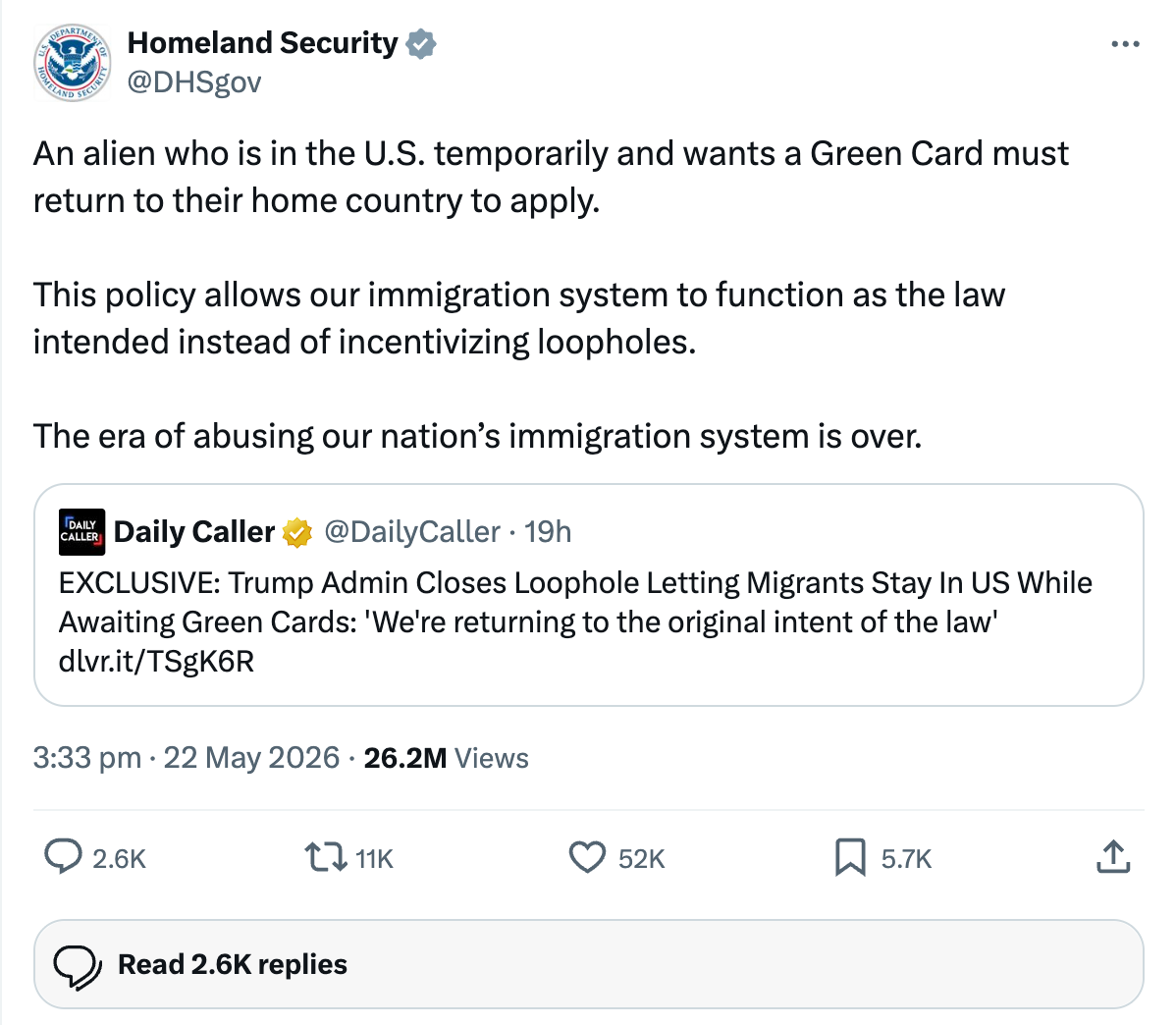
On May 21, 2026, US Citizenship and Immigration Services issued Policy Memorandum PM-602-0199. The memo treats adjustment of status as “a matter of discretion and administrative grace” rather than the default route to a green card for people already living in the United States. The agency’s news release went further and said USCIS will grant adjustment only in “extraordinary circumstances.” The Department of Homeland Security repeated the message a day later:
European founders and executives with a green card petition in progress read those headlines and started calling us. Most of the alarm comes from a press release that says more than the memo does.
The statute under INA Section 245 was not amended. Officers retain the discretion they have always had. What USCIS changed is how it tells them to use it: heavier scrutiny, more requests for evidence, more denials at the margin for applicants who entered on a single-intent visa and then tried to convert their visit into permanent residence. For most of the European applicants we advise, the choice between adjustment of status and consular processing now leans toward consular processing, even when adjustment is technically available.
Vinland Immigration has worked these cases for years for clients in Germany, Austria, Switzerland, France, and the Nordics. We have argued route selection across EB-1, EB-2 NIW, EB-5, L-1, O-1, and family-based files, and we can read a specific case on short notice when a policy change like this one upends the plan you already had. If you have a pending I-485, a petition ready to go out, or a 2026 timeline that now needs a second look, get in touch and we will work through the route choice with you.
What did the memo actually say?
The May 21, 2026 policy memo directs USCIS officers to treat adjustment of status as a discretionary benefit, not an entitlement, and to weigh both positive and negative equities before approving a Form I-485 even when the applicant meets every statutory requirement.
PM-602-0199 is a USCIS Policy Manual directive that reaches every officer adjudicating Form I-485. USCIS spokesman Zach Kahler told reporters the agency is “returning to the original intent of the law to ensure aliens navigate our nation’s immigration system properly.” Coverage from NBC News, PBS, Global News, and the Washington Examiner carries the same description of the announcement.
The legal substance is narrower than the announcement. The American Immigration Lawyers Association (AILA Doc. 26052231) reads the memo as asserting that adjustment is “administrative grace” rather than a right, and as instructing officers to require outstanding equities to overcome adverse factors. Nothing in INA Section 245 itself was changed. The employer advisory from WR Immigration reduces the operative directive to one sentence: officers will apply “heightened discretionary scrutiny in cases where an applicant’s conduct appears inconsistent with the purpose of their temporary admission, parole, or nonimmigrant status.”
The statutory right to file Form I-485 under INA § 245 has not been repealed. A policy memo cannot override the statute. What the memo does is shift the standard officers apply once a case is in front of them, from “is this applicant eligible” to “should this applicant receive a discretionary benefit instead of going through consular processing.”
Who is most affected, and who is mostly spared?
Single-intent nonimmigrants who file adjustment of status face the largest swing in adjudication standard. Immediate relatives of US citizens and dual-intent visa holders are better off, though no category is fully out of reach.
There are four rough tiers of exposure.
- Largely spared
- Immediate relatives of US citizens (spouses, parents, minor children), VAWA self-petitioners, refugees, asylees adjusting under INA Section 209, and Special Immigrant Juveniles. These pathways are either statutorily mandatory or built around humanitarian intent that the memo preserves.
- Better positioned but not safe
- Dual-intent nonimmigrants, principally H-1B, L-1, and their H-4 and L-2 dependents. Congress designed these categories to allow pursuit of permanent residence, and USCIS concedes the point. But a footnote in the memo walks the concession back: maintenance of dual-intent status is “not sufficient on its own to warrant a favorable exercise of discretion.” Translation: you still need to show affirmative equities.
- Exposed
- Single-intent nonimmigrants pursuing employment-based green cards from inside the US. F-1 students, B-1/B-2 visitors, J-1 exchange visitors, and TN professionals with approved I-140s fall here. Their AOS filing reads, on the memo’s terms, as inconsistent with the purpose of their original admission, which is exactly the negative factor officers are told to weigh.
- Most exposed
- Anyone with a status history blemish: a prior overstay, unauthorized employment, parole-based entry, a prior misrepresentation, or a record of failing to depart on schedule. The memo names “failure to depart as expected” as its own negative discretionary factor, regardless of current status.
Two short examples for European applicants. A German founder on E-2 who tries to adjust to a green card from inside the US has a real problem: the E-2 is a single-intent treaty-investor visa, and converting that stay into permanent residence is exactly the pattern the memo flags. A Swedish executive on O-1 self-petitioning for EB-1A is in a different position: O-1 is treated as dual-intent in practice, so the AOS still works on the merits, provided the discretionary record is built into the file.
Why does the framing matter so much if the law has not changed?
USCIS outcomes turn on officer-level discretion as much as on the statute. A memo that tells officers to default to skepticism changes denial rates without amending a regulation.
Two things compound. The memo lists factors that justify denial and says almost nothing about factors that justify approval. Officers facing borderline files now have a documented basis for saying no, and far less documented basis for saying yes. The memo also requires officers to write positive and negative equities into the decision itself, which creates an audit trail for denials and a quiet incentive to write the negative case rather than approve without explanation.
The Lexelite analysis of PM-602-0199 puts it directly: “Eligibility gets you in the door. Discretion decides whether you walk out.”
We have seen this before. The H-1B Specialty Occupation memos from 2017 to 2020 did not change the statute either. They reshaped denial rates by changing the standard officers were told to apply. We expect a similar effect here over the next twelve to eighteen months.
How does this change the choice between AOS and consular processing?
For European applicants, consular processing becomes the safer default in 2026 because it sidesteps the discretionary risk entirely while preserving full statutory eligibility.
Our consular processing vs adjustment of status article walks through the mechanics in detail. The post-memo update is one of weighting, not mechanics.
The exception is when leaving the US would be operationally or legally worse than the discretionary risk. The clearest case is someone who entered on ESTA, married a US citizen, and now wants to adjust on that marriage. We do not yet know how USCIS will read those files under the new memo: the statutory route under INA Section 245(a) is unchanged, but the discretionary lens is brand new, and ESTA was never designed as a pre-immigration channel. Anyone in that position should talk to us before filing. The right answer is case-specific and very much still being shaped. The same goes for a pending US-citizen spouse case with a recent overstay, a complex parole record, or unlawful presence sitting just outside the file: departure itself can be the dangerous step, and those cases need counsel before anyone books a flight.
What about people whose I-485 is already pending?
Pending I-485 applications stay valid, but applicants should expect more requests for evidence, harder interviews on discretionary factors, and longer timelines.
The memo applies prospectively to how officers adjudicate, not to which applications are accepted. There is no grace period for cases already filed. A pending I-485 from early 2026 will be reviewed under the new standard whenever the officer picks it up.
The right response is documentation discipline. The same firms that advise building affirmative equity packages for H-1B and L-1 applicants recommend assembling the same materials for any pending file: complete prior-status history with every I-797 approval notice, tax transcripts for each year of US presence, employment records, evidence of community and family ties, and supporting letters from employers and community members. The point is to give the officer a documented reason to approve, not to argue eligibility a second time.
“For pending cases, the worst thing we can do is wait for an RFE and then scramble,” says Kari Foss-Persson, Esq., Managing Partner at Vinland Immigration. “The discretionary record is now part of the petition. Filing without it and hoping for a quiet approval is a 2023 strategy. In 2026 we build the equities into the original file and answer the discretionary question before the officer asks it.”
What does this mean for European employment-based candidates specifically?
European EB-1, EB-2 NIW, and EB-5 candidates based in Europe should default to consular processing. Candidates already in the US should rebuild any inside-the-US AOS plan around an affirmative discretionary record before filing.
For most of our European clients, the geography already pointed that way. A Frankfurt-based EB-1A self-petitioner, a Vienna-based EB-2 NIW applicant, or a Stockholm-based EB-5 investor was almost always going to finish the case at the local US embassy. The memo strengthens that default; it does not change it.
The harder cases are the ones where there was a real reason to adjust from inside the US:
- EB-1C executives transferred on L-1A
- AOS is still filable, and the L-1 dual-intent designation helps. But the file needs to show that the US executive role is a real continuation of the EU role, that compensation is at or above prevailing wage, and that the green card is the natural next step of a multi-year transfer plan rather than a status conversion.
- EB-2 NIW researchers already in the US on O-1 or H-1B
- Reassess whether the petition tells one coherent story across both layers. The merit case that won the I-140 should also work as the discretionary case for the I-485. Splitting them invites the officer to approve the merit and deny the discretion.
- EB-5 investors with US-based founders or operators
- Direct EB-5 investors who entered on E-2 to operate their business are usually in a workable position. Passive regional center investors who entered on a tourist visa to attend project tours are exposed and should plan to consular process. Our EB-5 regional center sunset guide covers the parallel September 30, 2026 program-level deadline.
- EB-1A and EB-2 NIW self-petitioners on O-1
- The O-1 is dual-intent in practice but not in statute. The discretionary case is closer to a single-intent profile than an L-1 or H-1B profile. Build the equity package proactively.
Our EB-1 green card guide, EB-2 NIW guide, and EB-5 investor visa guide cover the underlying categories. The 2026 adjustment is not which category to choose. It is how to finish the case once the petition approves.
How does this fit with the rest of the 2026 immigration shift?
The May 21 memo arrived in the middle of a broader tightening that includes rising denial rates, expanded consular screening, prevailing wage hikes, and the H-1B freeze proposal. The right strategy responds to the pattern, not to any single rule.
The memo is not standalone. It runs alongside the rising denial rates and expanded screening that USCIS and the State Department have rolled out across most visa categories, the H-1B freeze and $200K salary floor proposal that is reshaping how European tech professionals plan their relocation, and the EB-5 regional center sunset on September 30, 2026. Each rule is manageable on its own. The combination is what changes the case strategy.
What are people saying about the policy?
Reactions split into roughly three camps: administration officials defending the memo as a return to statutory intent, immigration practitioners warning of family separation and founder exits, and tech leaders calling the policy shortsighted. Administration officials called the memo a return to statutory intent. Practitioners and former USCIS staff warned of family separation, founder exits, and a Catch-22 for applicants whose home-country consulates are backlogged or closed. Tech and venture capital were the loudest critics.
Nick Davidov, a Silicon Valley investor, called the move “the biggest bullshit move by DHS in its history” and argued the consequence would be that “everyone on a O1 or H1B visa would have to stop working legally in the US, go back to their country and wait for years of backlog.” Reid Hoffman, LinkedIn co-founder, described it as “harmful for tech, business, and America broadly.”
The immigration bar was sharper on the legal substance. Todd Pomerleau, an immigration attorney, told reporters: “You can’t, through a stroke of a pen, overturn a statute. It’s illegal, and it’s going to get shut down in court.” AILA’s Shev Dalal-Dheini said USCIS “is trying to upend decades of processing of adjustment of status. This all applies very broadly to anyone seeking a green card.” Doug Rand, a former senior USCIS advisor, told Global News the policy reaches the roughly 600,000 people who file adjustment of status each year, and said the central effect was “to make it difficult or impossible for very large numbers of U.S. citizens to get on with their lives with the people they’ve chosen to marry.” Michael Valverde, a former senior USCIS official, told CBS News the change is “a largely unprecedented move that will limit lawful immigration to the U.S. greatly. People who followed the rules faithfully now face tremendous uncertainty.”
The administration’s framing went the other way. The DHS post on X phrased the policy as ending an “era of abusing our nation’s immigration system.” Within 24 hours, USCIS quietly walked that framing back in comments to Semafor, telling the outlet that “people who present applications that provide an economic benefit or otherwise are in the national interest will likely be able to continue on their current path.” That carveout does not appear in the memo, which is part of why it matters. USCIS is telling reporters what it did not tell its own officers in writing: EB-1, EB-2 NIW, EB-5, and other economic-merit cases are not the cases this memo was written to stop.
The legal commentary has been calmer than the political reaction. Boundless reads the operative memo as narrower than the press release suggested and continues to advise family-based applicants to file. Murthy Law, Erickson Immigration Group, WR Immigration, and Reddy Neumann Brown all land on the same posture: file when you must, but build the discretionary case into the original submission.
What should you do this quarter?
“The right move is rarely the same for two clients,” says Kari Foss-Persson, Esq., Managing Partner at Vinland Immigration. “The memo did not change the law. It changed how aggressively the officer reads the same file. The strategy starts with looking at what is already on paper, and then working backward to the route that protects the case.”
What to do depends on where your case stands now.
- If your I-485 is already pending
- Do not panic, but do not wait either. Pull the file, add a supplemental discretionary submission covering status compliance, tax history, employment, family ties, and community involvement, and prepare counsel for an RFE that may not come but probably will.
- If your I-140 is approved and your priority date is current
- Decide between AOS and consular processing on the new standard, not the old one. For European applicants based in Europe, consular processing is almost always the right answer in 2026. For US-based H-1B and L-1 applicants, AOS is still filable but needs the discretionary record built into the original I-485 package.
- If you are still planning the petition
- Plan the consular route by default if you are based in Europe. Build the equity record into the case from the start if you are based in the US. Do not file a 2023-era petition into a 2026 adjudication environment.
- If you entered on a single-intent visa
- Get counsel before filing AOS. The memo was written with your profile in mind.
Do not depart the United States to “fix” a status problem without counsel first. Departing with unlawful presence on the record can trigger three- or ten-year reentry bars that destroy a consular processing strategy outright. The right route depends on the full file, not on the surface read that the memo prefers consular processing.
The bottom line for European applicants
The May 21 memo did not close the in-country green card path. It made that path harder to use and more dependent on discretion than on eligibility. For applicants based in Europe, the memo just confirms what we were already going to recommend in most cases: consular processing. For applicants already in the US, the work shifts from proving eligibility to giving the officer a documented reason to approve.
Adjustment of status is still legal, just harder to use. European applicants based in Europe should default to consular processing. European applicants in the US on dual-intent visas should treat the I-485 as a discretionary petition, not a status conversion form. Single-intent visa holders should reconsider the route entirely. The burden of proof has moved, even where the statute has not.
Our outline of the US visa process covers the underlying structure, the consular processing vs adjustment of status article walks through the route-choice mechanics, and our permanent residency guide maps the full set of green card categories. If your 2026 plan has just been disrupted by the new memo, reach out. We work these cases every week and can give you a clear read on your specific file within days, not months.